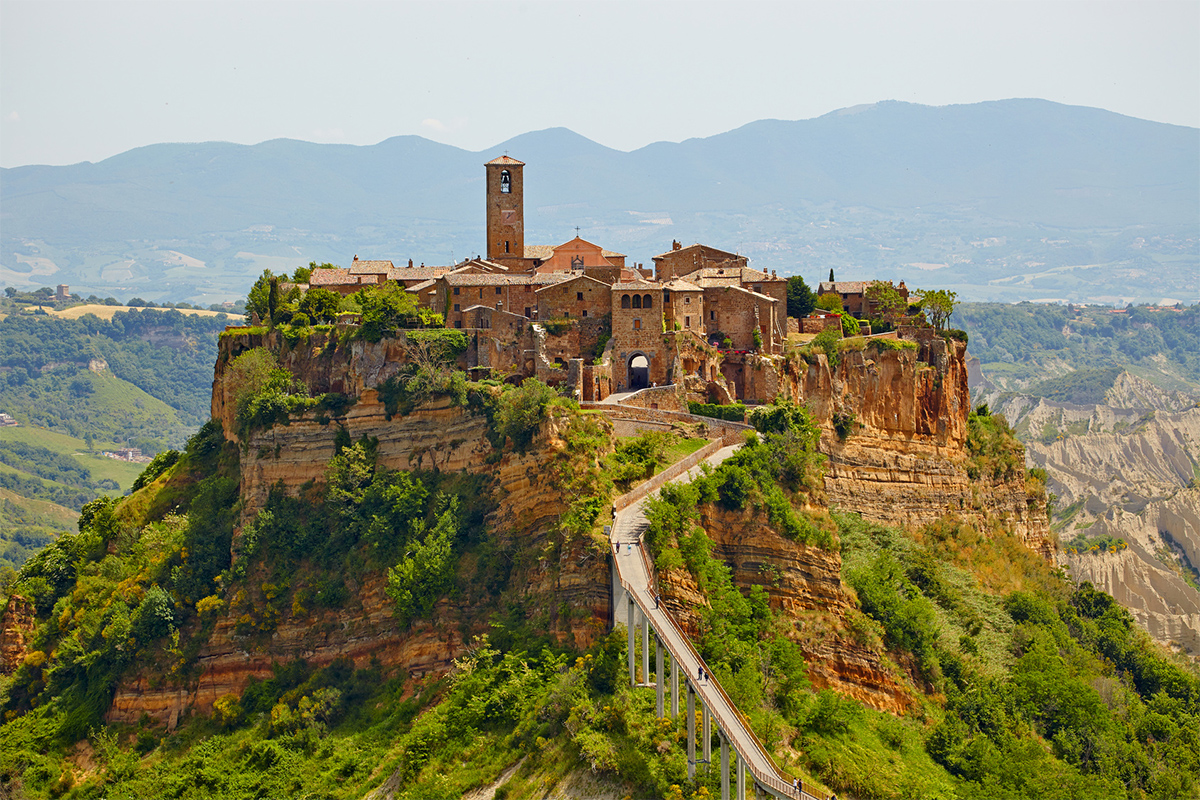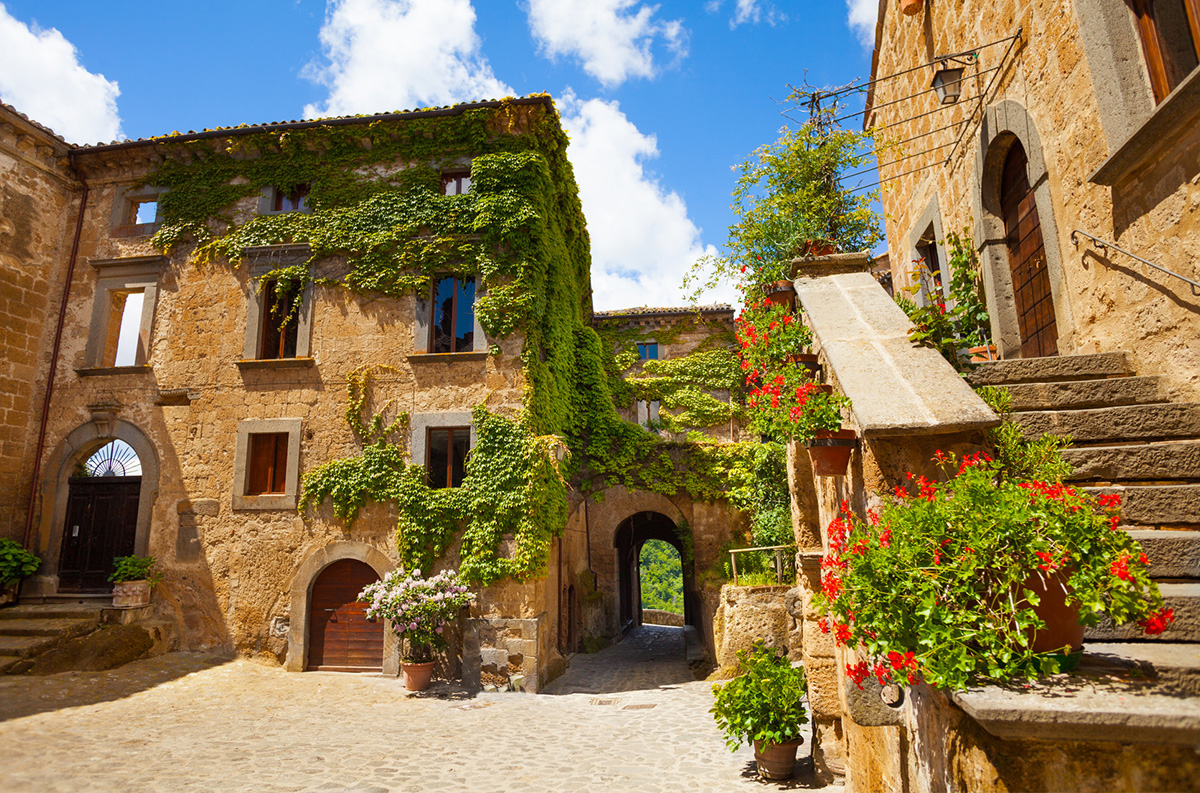

In fact, Civita di Bagnoregio stands on very precarious ground, situated on a tufa plateau, risking collapse because the vast clay banks that support it are subject to continuous erosion. BALNEUM REGIS first appears in 599/600in a letter from Pope Gregory the Great addressed to the Bishop of Chiusi Ecclesius. There are no earlier documents attesting to the toponym or latra denomination. Balneum regis is a toponym of Gothic-Lomgobard origin, defining a royal property. A connection with a spa complex, of which there is not extensive evidence, is not unlikely. The first certain historical records of Bagnoregio, or rather Bagnorea, this is its oldest name, date back to the sixth century A.D. when it is mentioned among the Italian episcopal sees. It is certain, however, that after the fall of the Roman Empire Bagnoregio fell under the dominion of the Goths first and the Lombards later, and finally Charlemagne gave it to the Papacy along with the remaining part of the Patrimony of St. Peter in Tuscia. After the Frankish conquest a series of feudal lords alternated in the exercise of power, notable among them are the Monaldeschi who later became lords of Orvieto. In the 12th century it became a free commune, experiencing a period of prosperity and cultural and artistic vibrancy. Incumbent, however, remained the threat of the nearby powerful Orvieto in the political orbit of which Bagnoregio di must certainly be placed in this period. At times relations between the two cities became bitter and conflictual, and neighboring centers were also drawn into the struggles. However, even though involved in wars and attempts at occupation Bagnoregio managed to maintain a relative autonomy. The tremendous plague epidemic of 1348 ( the one narrated in Boccaccio's Decameron) reduced the town a shadow of its former self; it is said that in a single day there were more than 500 deaths. In 1494 the Bagnoresi succeeded in destroying the fortified fortress of the Monaldeschi della Cervara to free themselves for good from the danger of the return of the hated tyrants. In 1494 The Bagnoresi bravely opposed the entry into the city of the French king Charles VIII headed with his army to Naples to occupy it. The heroic act was not matched, however, by any recognition from Pope Alexander VI Borgia, who two years later dealt a blow to the proud sentiment of communal freedom by instituting the regime of Cardinal-Governors that lasted until 1612, the year Bagnoregio came under the control of the Apostolic Delegation of Viterbo, which undertook to respect the ancient communal statutes of 1367. The life of the Bagnoregio community flowed quietly disturbed more by the natural and geological vicissitudes of their town rather than by political events or events of arms. Only in 1867 was there a military upheaval when the first violent clash between the papal militia and Garibaldi's volunteers occurred, which history remembers as "The Battle of Bagnorea." In 1870, finally Bagnoregio became part of the Kingdom of Italy. Civita di bagnoregio is a place where a mysterious and mysterious charm is captured. Vestiges that have not yet been interpreted, a vast network of underground tunnels, and its very geographic location have given rise, even in recent times, to analysis and hypotheses about its origins and rituals to the point of identifying it as one of the possible sites of the Fanum Voltumne, the sanctuary of the Etruscan nation.