
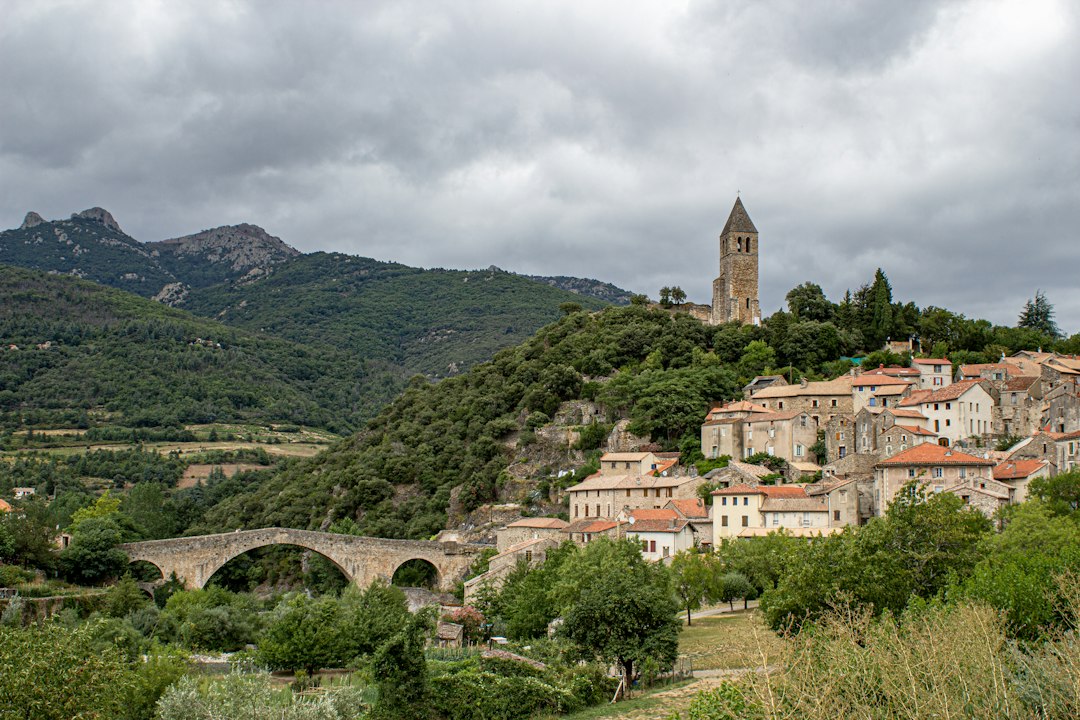
The stones of the Devil's Bridge are smoothed by time and the steps of those who have walked on them for almost a thousand years. This unique arch bridge, built in the 11th century, spans the Orb River in the heart of Olargues, one of the villages that the French government has officially included in the list of the «Most Beautiful Villages in France», the most beautiful villages in the nation. This is not a symbolic distinction: to obtain this recognition, a municipality must meet strict criteria for architectural and landscape heritage.
What strikes you even before stepping onto the bridge is its structural simplicity: a single arch made of local limestone that stretches from one bank to the other of the Orb, without ornaments, without concessions to the superfluous. Yet that essential curve bears the weight of the centuries with an elegance that many more elaborate works fail to match. The popular name — Devil's Bridge — reflects a widespread medieval belief throughout Europe: when an engineering work seemed too perfect to be human, its construction was attributed to supernatural forces.
History and construction: the 11th century in stone
The Pont du Diable of Olargues dates back to the medieval period, around the 11th century, a time when the construction of stone bridges represented a technical undertaking of great complexity. The single arch, the distinctive feature of the bridge, requires a precise understanding of load distribution: each stone of the arch — the so-called voussoir — works in compression, transmitting the weight to the lateral shoulders anchored in the rock. This technique, inherited from Roman engineering and reinterpreted by medieval builders, has ensured the survival of the structure for almost a millennium.
The choice of site was not random. Olargues was located along ancient communication routes in the heart of the Hérault, in the Occitanie region, and controlling the crossing of the river had an evident strategic and commercial value. The bridge was not just an infrastructure: it was a gathering point, a place of exchange, a meeting point. This social function has never ceased — even today, residents cross it daily, on foot or by bicycle, to reach the two banks of the town.

What to see on site: details not to be missed
Standing on the bridge and looking upstream, one has one of the most photogenic views of the entire Orb valley: the turquoise-green waters of the river flow between wooded banks, while the profile of the medieval village of Olargues stands out in the background, dominated by the bell tower of the church that rises on the hill. Looking downstream, the gorge narrows and the Mediterranean vegetation — oaks, scrublands, pines — covers the slopes down to the water.

The surface of the bridge is paved with irregular stone, worn in the center from continuous passage. The lateral shoulders show the signs of time: moss, small rock plants that have found a home in the cracks between the blocks. There are no modern metal railings — just a low stone wall on both sides, which gives the structure an authentic appearance that has not been invasively restored. Those who stop for a few minutes can observe the fishermen who frequent the banks of the Orb, especially on summer mornings.
The gorge trail: beyond the bridge

The Pont du Diable is not just a destination in itself: it is also the starting point of the trail that runs through the Orb gorge, a hiking route that develops along the banks of the river through landscapes of great natural beauty. The path is accessible to medium-level walkers and offers glimpses of the typical vegetation of lower Languedoc, with sections that run alongside the water just a few centimeters from the current.
This connection between historical heritage and nature is one of the elements that makes the visit particularly satisfying: one can combine the contemplation of the bridge with a one or two-hour hike in the gorge, then return to the village for a meal in the small restaurants of the historic center. Olargues has several trattorias and cafes that offer local products from Hérault, including wines from the area and typical cheeses from Occitania.
Practical tips for the visit
The best time to visit the Pont du Diable is in the early morning, between 7 and 9, when the slanting light illuminates the stones of the arch and the river is often shrouded in a light mist. In summer, during the central hours of the day, the site becomes crowded with tourists and the temperatures in the gorge can be high. The visit to the bridge itself takes about 20-30 minutes, but those who want to walk the gorge trail should plan for at least a couple of additional hours.
Access to the bridge is free and open in every season. Olargues can be reached by car via the D908, the road that climbs the Orb valley from Bédarieux towards Saint-Pons-de-Thomières. There is no train station in the village, so private transport is practically essential. Parking available nearby is limited: it is advisable to arrive early, especially in July and August, when tourist attendance in the area is at its seasonal peak.