← Back

Mongiana Ironworks

89823 Mongiana VV, Italia ★★★★☆ 213 views
Sveva Yale
Mongiana
🏆 AI Trip Planner 2026

Get the free app

Discover the best of Mongiana with Secret World — the AI trip planner with 1M+ destinations. Get personalized itineraries, hidden gems and local tips. Free on iOS & Android.

🧠 AI Itineraries 🎒 Trip Toolkit 🎮 KnowWhere Game 🎧 Audio Guides 📹 Videos
Scan to download iOS / Android
Scan for AppGallery Huawei users

About Mongiana Ironworks

Mongiana Ironworks - Mongiana | Secret World Trip Planner

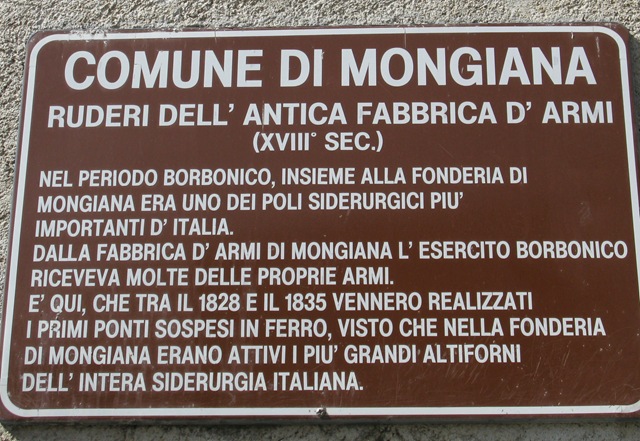
Today we look at the ironworks of Mongiana, an impressive iron and steel hub founded between 1770 and 1771 by the Bourbon dynasty. The town of Mongiana is located in the province of Vibo Valentia, Calabria. This site has an emblematic significance: it was Italy's largest iron and steel hub, whose products enabled the beginning and development of the industrialization of Naples and its province, and then became a symbol of the Southern Question, following its closure 20 years after the unification of Italy.

Mongiana Ironworks - Mongiana | Secret World Trip Planner

But let us go in order. The complex, which was built by Neapolitan architect Mario Gioffredo, employed about 1,500 workers and churned out about 1,442 rifle barrels and 1,212 pistol barrels in a year. For those times it can be considered an extraordinary achievement, the result of research and retraining work carried out by two of the main Bourbon rulers-Charles III of Bourbon and Ferdinand IV. The former, having realized the backwardness of the working methods of the workers who worked inside the steel plant, after a long search for Europe, found and sent Saxon and Hungarian mineralogists to Calabria so that they could teach those workers new production methods. Moreover, the ruler apparently also had a certain sensibility that today we might call ecological. In fact, in 1773 Charles III of Bourbon issued the salvaboschi decree to prevent the company's own expansion from causing substantial damage to the surrounding environment. Ferdinand also decided to implement changes to Mongiana's production system to improve its quality while safeguarding the environment. Under Ferdinand the business began to produce railroad equipment. It was the Real Ferriera di Mongiana that conceived the material that would give rise to the Naples-Portici railway line and the suspension bridge over the Garigliano, which in turn represent other great firsts of the ancient kingdom. Steel products will be indispensable for the birth and evolution of Pietrarsa's first locomotive plant.

Mongiana also holds the record as the first iron and steel complex in the Italian peninsula. Unfortunately, following the unification of Italy in 1861, this, like other large southern facilities, will fall victim to a deep crisis due to mismanagement by the central state and a total lack of subsidies. This crisis will be so deep that it will lead to its final closure in 1881.
Mongiana Ironworks - Mongiana | Secret World Trip Planner
🗺 L'app des trésors cachés

Plan your visit to Mongiana

Suggested itinerary near Mongiana Ironworks

MAJ+
500.000+ travelers worldwide
  1. 🌅
    Morning
    Mongiana Ironworks
    📍 Mongiana
  2. ☀️
    Afternoon
    The Charterhouse of Serra San Bruno
    📍 5.9 km · Mongiana
  3. 🌆
    Evening
    Marmarico Waterfall
    📍 6.8 km · Mongiana

Buy Unique Travel Experiences

Powered by Viator

See more on Viator.com

Explore nearby · Mongiana

Frequently Asked Questions

The Mongiana Ironworks was founded between 1770 and 1771 by the Bourbon dynasty in the province of Vibo Valentia, Calabria. The complex was designed and built by renowned Neapolitan architect Mario Gioffredo and represented Italy's largest iron and steel hub of its time.
The ironworks employed approximately 1,500 workers and was an extraordinary production facility that churned out about 1,442 rifle barrels and 1,212 pistol barrels annually. Later, under Ferdinand IV, the facility expanded to produce railroad equipment, including materials for the Naples-Portici railway line and the Garigliano suspension bridge.
Charles III of Bourbon issued the salvaboschi decree in 1773 to prevent the ironworks from causing substantial damage to the surrounding environment. Ferdinand IV further implemented changes to improve both production quality and environmental protection, demonstrating early ecological sensitivity for the industrial era.
After recognizing the backwardness of local working methods, Charles III conducted an extensive search across Europe and sent Saxon and Hungarian mineralogists to Calabria to train the workers in modern production techniques. This initiative was crucial in developing the facility into a world-class industrial operation.
The ironworks closed approximately 20 years after the unification of Italy, becoming a symbol of the Southern Question and representing the decline of Southern industrial capacity. Despite its earlier significance in enabling the industrialization of Naples and its province, the facility could not sustain operations in the unified Italian economy.