← Back

Navel of Italy

Piazza S. Rufo, 02100 Rieti RI, Italia ★★★★☆ 169 views
Mary Stoone
Rieti
🏆 AI Trip Planner 2026

Get the free app

Discover the best of Rieti with Secret World — the AI trip planner with 1M+ destinations. Get personalized itineraries, hidden gems and local tips. Free on iOS & Android.

🧠 AI Itineraries 🎒 Trip Toolkit 🎮 KnowWhere Game 🎧 Audio Guides 📹 Videos
Scan to download iOS / Android
Scan for AppGallery Huawei users

About Navel of Italy

Navel of Italy - Rieti | Secret World Trip Planner

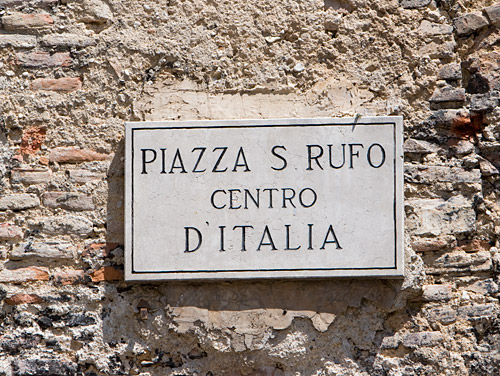
The name of the city of Rieti is traditionally associated with the label "center of Italy": in fact, the Romans identified the median point of our peninsula in Piazza San Rufo, where stands a peculiar monument that the inhabitants of the Sabine capital are used to refer to as "caciotta" because of its rounded appearance that resembles the outline of a cheese wheel. The work was created at the turn of the 1980s and 1990s as a result of the twinning between Rieti and the Georgian capital Tblisi: the "caciotta" seems to resemble the base of a column and has on its surface the design of the Italian peninsula, accompanied by the epigraph "Umbilicus Italiae" that runs along the semi-circular shape of the monument itself.

Navel of Italy - Rieti | Secret World Trip Planner

A disputed center - The "caciotta" of Piazza San Rufo rises to the role of a tangible sign of the disputed primacy over the geographic center of Italy: the testimonies of the literati Marcus Terentius Varro, Dionysius of Halicarnassus and Virgil have for centuries delivered to the city the undisputed role of "Umbilicus Italiae," however, scientific progress has paved the way for the most disparate discussions on the actual validity of this geographic peculiarity. The Military Geographical Institute has attributed primacy to the city of Narni, in the province of Terni: the various measurement criteria adopted have also included Foligno, Orvieto, Monteluco and even a parking lot in Torre Spaccata, a suburb of Rome, in the contention.
Navel of Italy - Rieti | Secret World Trip Planner
🗺 L'app des trésors cachés

Plan your visit to Rieti

Suggested itinerary near Navel of Italy

MAJ+
500.000+ travelers worldwide
  1. 🌅
    Morning
    Navel of Italy
    📍 Rieti
  2. ☀️
    Afternoon
    Rieti | Flavio Vespasiano Theatre
    📍 0.1 km · Rieti
  3. 🌆
    Evening
    Convent of Fonte Colombo: the Franciscan Mount Sinai
    📍 3.8 km · Rieti

Buy Unique Travel Experiences

Powered by Viator

See more on Viator.com

Explore nearby · Rieti

Frequently Asked Questions

The 'caciotta' is a peculiar rounded monument located in Piazza San Rufo that marks Rieti's claim as the geographic center of Italy. It's called 'caciotta' by locals because its rounded appearance resembles the outline of a cheese wheel, and it features the design of the Italian peninsula with the inscription 'Umbilicus Italiae' on its surface.
The monument was created at the turn of the 1980s and 1990s as a result of a twinning agreement between Rieti and Tblisi, the capital of Georgia. The work commemorates this international sister-city relationship while celebrating Rieti's historic designation as the center of Italy.
Rieti's claim to be the geographic center is historically supported by ancient Roman scholars including Marcus Terentius Varro, Dionysius of Halicarnassus, and Virgil, who all identified it as the 'Umbilicus Italiae.' However, modern scientific measurements have disputed this, with the Military Geographical Institute attributing the title to Narni, while other measurements have pointed to Foligno, Orvieto, and other locations, making it a genuinely contested geographic distinction.
The caciotta monument stands in Piazza San Rufo in Rieti, where the Romans traditionally identified the median point of the Italian peninsula. This central plaza is the main gathering point where visitors can see this iconic rounded monument marking the city's claim as Italy's navel.
The inscription reads 'Umbilicus Italiae,' which is Latin for 'Navel of Italy,' running along the semi-circular shape of the monument itself. This classical phrase references the ancient Roman identification of Rieti as the geographic and symbolic center of the Italian peninsula.