





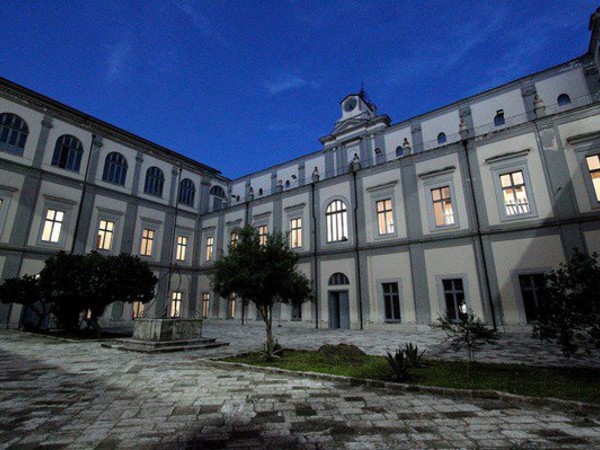
The founding of Nola under the name NUV-LA, new city, is supposed to date back to the 6th-5th centuries B.C. by the Oscans, as the Cippus Abellanus, a limestone stone written in the Oscan language, now preserved at the Episcopal Seminary in Nola, would seem to attest.
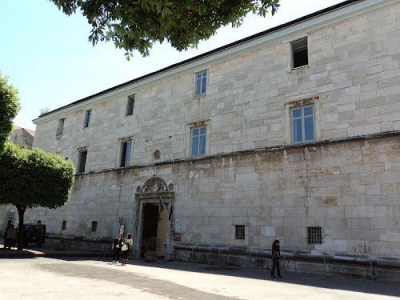
The adjective new would have been used to distinguish it from the old city, HYRIA, which arose on the slopes of the nearby northeastern hill of the present city and was perhaps destroyed by natural disasters .
Archaeological finds on its territory testify that Nola must have been under the beneficial influence of Etruscan and Greek civilization.
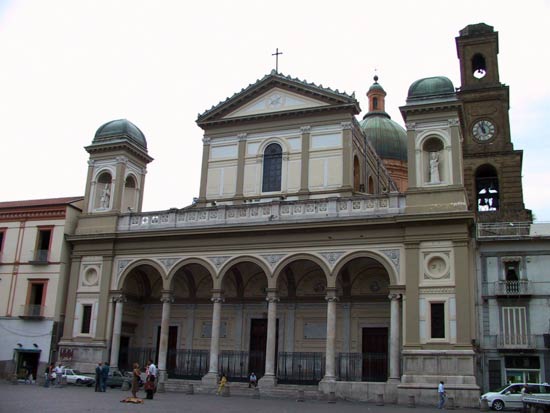
The city, reached such a level of wealth and luxury that it attracted the attention of the Samnites,a warlike people who inhabited Samnium.
When the Romans declared war on the Samnites in order to seize the rich and fertile lands of Campania, the history of Nola became intertwined with that of Rome, with alternating vicissitudes of rivalry and friendship: because of the courage and valor shown by the Nolans in defending the city in the second Samnite war, the Romans elevated it to Municipium; during the period of the Carthaginian wars it was most loyal to Rome but, later, seeing its autonomy diminished, it participated in the revolt of the Italics against Rome and, after ten years of resistance, in 80 B.C.C. it was conquered by Sulla, who established a colony of his veterans there.

After a ruinous servile war that ended the Res publica Nolanorum, Nola raised its fortunes only with Augustus by becoming the Nolana Colonia Felix Augusta.
After the death of Augustus, which occurred in Nola itself in 14 B.C., a slow decline began for the city: from being an active center of traffic and commerce, it became a predominantly agricultural town.
The barbarian invasions only worsened the city's situation: in 410 it was sacked by Alaric's Goths who, among others, took St. Paulinus, bishop of Nola, prisoner; in 455 it was devastated by the Vandals and, in 594, by the Lombards .
Occupied by the Normans, it was incorporated into the Kingdom of the Two Sicilies.
In the early 1200s, Nola allied with Naples under Frederick II of Swabia. Involved in the wars between the Swabians and Angevins, in 1269 Nola and its lands were granted as a feud by Charles of Anjou to Guido di Monfort, who was invested with the title of Count of Nola.
Guido died in 1290 leaving no heirs and therefore the county passed to his son-in-law Romano Orsini with whom the Orsini Seigniory began. Nola returned to its former glory.
After the Orsini, with the Treaty of Cateau Cambresis, Nola passed to the Spaniards who, if they deprived the city of its freedom, fostered its cultural rebirth; just think of Ambrogio Leone and Giordano Bruno who lived during this period.
Remaining loyal to the Spaniards during Masaniello's revolt, Nola experienced severe economic and cultural decline in the 1700s, until under the reign of Charles of Bourbon, Bishop Troiano Caracciolo del Sole deployed his enlightened work in the city, founding the new Diocesan Seminary.
In 1820, from Nola itself, the Carbonari uprisings set out: lieutenants Morelli and Silvati and the Nola priest Minichini led the insurgents to demand the Constitution from Ferdinand I, king of the Kingdom of the Two Sicilies.
The city's civic vitality had a way of manifesting itself later, in 1943, with resistance to fascist oppression.
After World War II, having lost its military function, Nola sought to establish itself as an important commercial and economic center. Illustrious citizens of Nola were the philosopher Giordano Bruno, a strenuous defender of free thought, condemned by the Inquisition and burned alive in Rome, in 1600, and Pontius Meropius Paulinus, bishop of Nola, poet and saint, in whose honor the Feast of Lilies is celebrated every year in June, relevant to the city's religious, folkloric, anthropological and cultural traditions.