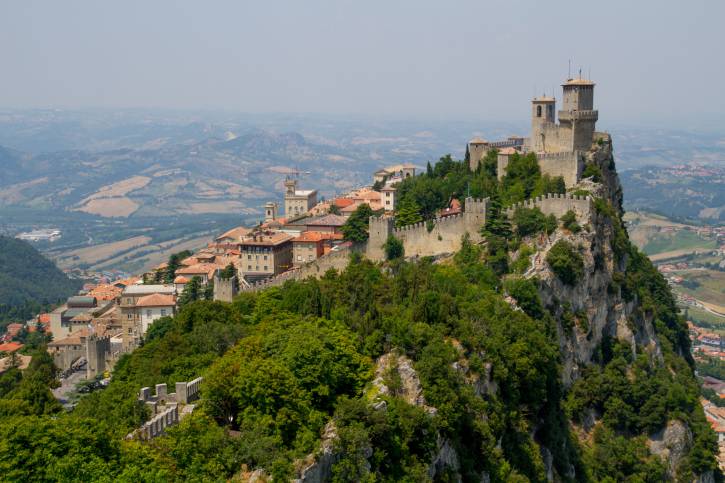

Legend traces the founding of the Republic to a stonecutter originally from Rab, Dalmatia, named Marino. He came to Rimini in 257 A.D. where he worked until he had to flee to escape persecution against Christians by Emperor Diocletian. He took refuge on Mount Titan. A charismatic personality and thaumaturge, on Mount Marino he managed to coalesce around him a small community of which he became the point of reference. Mount Titan was given to him by the owner, Donna Felicita (or Felicissima)to thank him for healing her sick son. There was territory, there was population. The sense of cohesion and independence was transfused to the community by Marino. It is said that his last words before he died were, "Relinquo vos liberos ab utroque homine." It was 301 A.D. and the seed of independence had been sown. Because the soil was fertile, it sprouted.
San Marino's first evidence of independence Beyond the legend, it is certain that Mount Titan with its slopes was inhabited since prehistoric times. This is evidenced by the numerous artifacts housed in the State Museum found in various excavation campaigns. The earliest document testifying to the existence of an organized community on the Mount is the Placito Feretrano, a parchment dated 885 A.D., preserved in the State Archives concerning a question of property rights over some land. The Placito attests that the property rights belonged to the Abbot of a Monastery located in San Marino.
The Early Statutes and Laws of San Marino. At the time of the Communes, the small community of Mount Titano began to outline its own form of government. The territory was called then "Land of San Marino," later it results as "Municipality of San Marino." The social body entrusted its self-government to the Arengo or assembly of heads of families, presided over by a Rector. As the population increased, a Captain Defender was appointed alongside the Rector. The most important institute in the state had been created. In 1243 the first two Consuls were appointed, the Captain and the Rector, who from then until the present day alternate every six months in the supreme office of the State: these are the Captains Regent, or Heads of State. The Arengo was responsible for establishing the first laws, the Statutes, inspired by democratic principles. The earliest Statutes date from 1253, but the first real body of state laws dates from 1295. The Statutes were rewritten and updated until the 1600 draft, which is the one to which the order refers.

San Marino's autonomy There were many dangerous situations that over the centuries the people of Mount Titano were able to cope with by consolidating their autonomy. Twice the Republic of San Marino was occupied militarily, but only for a few months: in 1503 by Cesare Borgia known as the Valentine and in 1739 by Cardinal Giulio Alberoni. From the Borgia he was able to free himself by the death of the tyrant. From Cardinal Alberoni he was able to escape by civil disobedience, demanding justice from the Supreme Pontiff, who recognized San Marino's good right to independence by the will of its people.
Napoleon Bonaparte's homage to San Marino. Napoleon in 1797 offered the San Marino people friendship, gifts and the extension of territory to the sea. The Sammarinese were grateful for the honor of such handouts, but instinctively declined territorial enlargement "paying for their borders."

The Garibaldi episode In 1849 General Giuseppe Garibaldi, military leader of the revolutionaries who were fighting to unify Italy, took refuge in San Marino with about 2,000 soldiers to escape the armies of Austria and Rome. All found refuge in San Marino territory. The authorities managed to prevent the entry of the Austrian troops by giving the Garibaldini time to leave the territory without bloodshed.
U.S. President Abraham Lincoln an honorary citizen Lincoln in 1861 demonstrated his sympathy and friendship for San Marino by, among other things, writing to the Captains Regent "... Although your domain is small nevertheless your State is one of the most honored in all history ... ".

San Marino's neutrality during World War II. San Marino boasts a tradition of exceptional hospitality throughout the ages. Indeed, in this land of freedom, the right of asylum and aid to the persecuted, of whatever condition, origin or idea, were never denied. During World War II San Marino was a neutral state, and although it had a population of only 15,000, it welcomed and sheltered 100,000 evacuees from neighboring Italian territory that was subject to bombing.