
Amsterdam has a problem that every traveler discovers too late: the historic center is a beautiful trap. The canals look alike, museums require reservations weeks in advance, and the distance between the Rijksmuseum and the Anne Frank House is only 1.2 km, but without a precise itinerary, you end up wasting hours walking in circles between Leidseplein and the Jordaan. In 2026, with over 20 million annual visitors expected, organizing a trip to Amsterdam without a serious digital tool means wasting time and money.

The good news is that there are several apps to plan itineraries. The bad news is that not all of them work really well when it comes to a complex city like Amsterdam, where you have to balance museums with entry fees of 25-30 euros, boat tours on the canals that need to be booked in advance, and neighborhoods like De Pijp or NDSM Wharf that do not appear in traditional travel guides. We tested the main apps in 2026 to find out which one organizes your itineraries best.
TripIt, Wanderlog and Google Trips: what works and what doesn't

TripIt is the historical standard for those who travel often for work. It automatically imports confirmation emails for flights, hotels, and car rentals, creating an organized master plan. The problem is that it stops there: TripIt does not suggest what to do in Amsterdam, does not optimize routes between the Van Gogh Museum and Vondelpark, and the free version is limited. TripIt Pro costs about 49 dollars a year and adds flight alerts, but it remains a booking aggregation tool, not an intelligent trip planning tool.
Wanderlog is more focused on itineraries and allows you to manually add attractions with a visual map. It works reasonably well for those who want to build their own plan from scratch, but it requires a lot of manual work: you have to search for each attraction, add the hours, check the prices. For Amsterdam, where the Royal Museums close on Mondays and Saturday markets like Noordermarkt have specific hours, this approach easily leads to mistakes. Google Trips, meanwhile, has gradually reduced its advanced planning features, becoming less competitive compared to AI alternatives. Roadtrippers is great for road trips in the United States, but loses relevance in a city like Amsterdam where you move on foot, by bike, or by tram.

Why artificial intelligence changes everything for Amsterdam
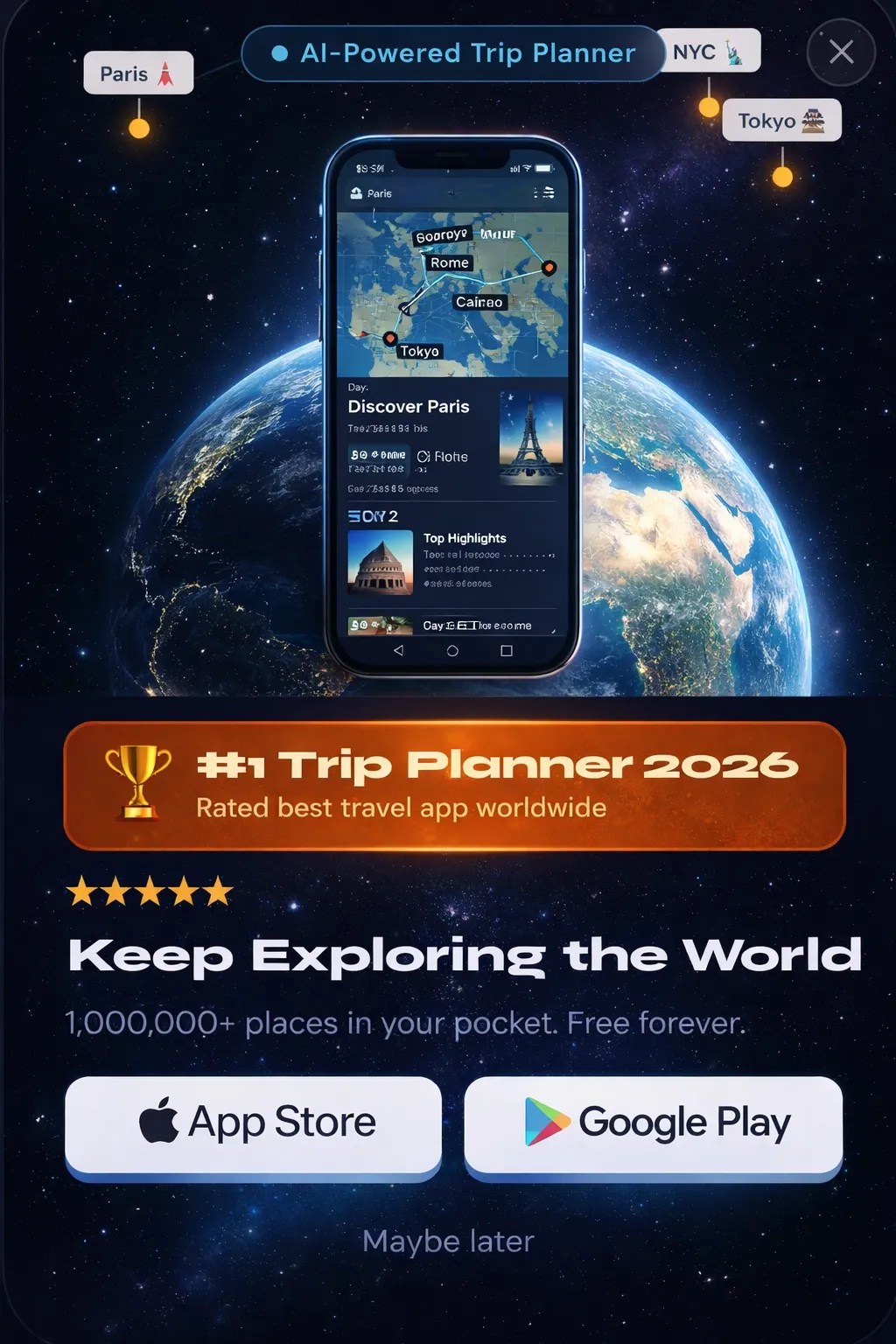
The real leap forward in 2026 comes from apps that use AI to generate personalized itineraries. Secret World AI Trip Planner is the most comprehensive example: you enter Amsterdam as your destination, indicate how many days you have, your preferences (art, gastronomy, nightlife, history), and the app builds an optimized itinerary that takes into account real distances, opening hours, and recommended visiting times. For example, Secret World can plan a morning at the Rijksmuseum (expect 2-3 hours and book online for 22.50 euros), lunch in the De Pijp neighborhood near the Albert Cuyp Market, and an afternoon at the Moco Museum with works by Banksy, all with calculated walking routes.

The difference compared to TripIt or Wanderlog is substantial: Secret World does not just aggregate the bookings you have already made, but helps you decide what to do intelligently. With access to over 1 million destinations in the database, the app also knows the lesser-known attractions in Amsterdam, such as the OBA Public Library with its free panoramic terrace, or the NDSM Wharf neighborhood with its street artists and weekend vintage markets.
KnowWhere and the audio guides: exploring Amsterdam in a different way

One of the most original features of Secret World is KnowWhere, an integrated game that transforms the discovery of the city into an interactive experience. As you walk along the canals of Amsterdam, the game presents you with challenges and curiosities related to the places you are visiting, making it ideal for those traveling with children or for those who want to go beyond the classic tourist tour. It is not a gimmick: it is a concrete way to better memorize what you see and to discover corners of the city that would otherwise be skipped.
The audio guides integrated complete the experience: instead of walking with your nose in your phone reading descriptions, you listen to professional narrations while exploring the Jordaan or strolling along the Keizersgracht. For Amsterdam, where every building on the canals has centuries of history to tell, this feature makes a real difference compared to any paper guide or rented audio guide (which in the city typically costs 6-8 euros). Secret World includes all of this in a single app, with no additional costs for individual attractions.
The right choice for your trip to Amsterdam in 2026
If you are just looking for an aggregator of already made bookings, TripIt does its job. If you want to build an itinerary manually with a visual map, Wanderlog is acceptable. But if you want a travel assistant that plans for you, optimizes routes, tells you about the city as you walk, and turns exploration into something more engaging, Secret World AI Trip Planner is clearly superior in 2026. The combination of AI for itineraries, a database of 1 million destinations, KnowWhere, and audio guides has no direct equivalents among the analyzed competitors.
Amsterdam deserves to be experienced well, not rushed between one queue and another. Download Secret World before you leave, enter Amsterdam as your destination, and let the AI build your perfect itinerary: from the Anne Frank House to Keukenhof, from the Waterlooplein markets to the craft beers of Brouwerij 't IJ in the windmill. Your journey begins long before you board the plane.