





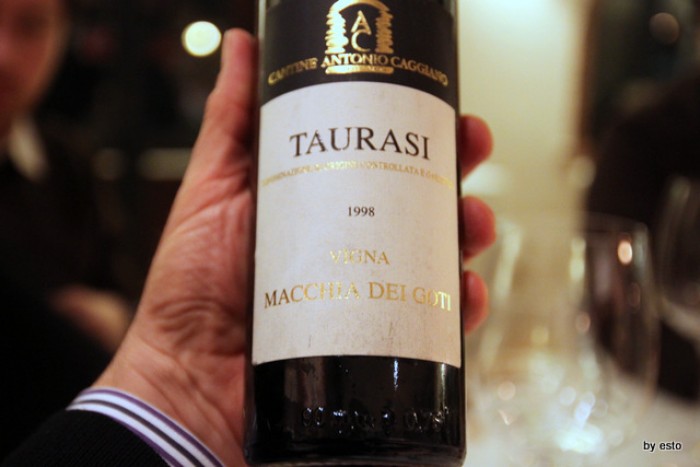
Production area: entire territory of the municipalities of Taurasi, Bonito, Castelfranci, Castelvetere sul Calore, Fontanarosa, Lapio, Luogosano, Mirabella Eclano, Montefalcione, Montemarano, Montemileto, Paternopoli, Pietradefusi, Sant'Angelo all'Esca, San Mango sul Calore, Torre le Nocelle and Venticano, all in the province of Avellino. Taurasi is an excellent wine from Campania is to be considered one of the best wines in Italy. The production area is northeast of Avellino and includes Taurasi and about fifteen other municipalities, all in the Avellino area. Taurasi, like many southern Italian wines, has pre-Romanesque origins: aglianico, the main grape variety from which this wine is made, was once called "hellenico" or "hellenica," emphasizing its Greek origin. Taurasi took its name from Taurasia, a small wine-producing village that the Romans made theirs after defeating the Hirpinians in 80 AD. They later moved several thousand Ligurian settlers to the area to work the vineyard lands. There are several historical quotations referring to Aglianico in general and to Taurasi in particular: at the end of the 16th century Andrea Bacci, physician to Pope Paul III, wrote that this wine "is prepared with rather dry grapes, made vigorous by oak and preserved in excellent jars; it is therefore perfumed and savory, pleasant to the taste, very pleasant and stable, of high nutritive power, corroborating to the stomach and limbs more than an aperitif." Grape varieties - Minimum alcohol content - Aging and qualifications
Grape varieties: Aglianico; other non-aromatic red grape varieties recommended or authorized for the province of Avellino may concur, up to a maximum of 15%. The wine must undergo a mandatory aging period of at least three years, at least one of which must be in wooden barrels. - Minimum total alcohol content by volume: 12%. - Minimum total acidity: 5 per thousand. - Minimum net dry extract: 22 per thousand. Controlled and guaranteed designation of origin "Taurasi" wine must undergo a mandatory aging period of at least three years, at least one of which must be in wooden barrels. If aged four years, including at least 18 months in wooden barrels, Taurasi may be called Riserva provided it has a total alcoholic strength by volume of 12.5%. Organoleptic characteristics.
- Color: intense and brilliant ruby, tending to garnet until acquiring orange reflections with age. - Smell: pronounced, broad, ethereal, pleasant more or less intense. - Taste: dry, austere, tannic when young, full, harmonious, balanced when mature, with a lingering aftertaste. The Riserva variety has more pronounced characteristics than Taurasi and a broader structure. Pairings and serving temperature

Taurasi is served at a temperature of 16-18°C to accompany dishes endowed with good aromatic depth: first courses with meat sauce, feathered game in casserole, roasted red meats, aged hard cheeses. The Riserva variety is a meditation wine to be served at a temperature of 18°C. At the table it should be paired with very flavorful main courses: red meats cooked for a long time in gravy or in wine, marinated and casseroled game birds.