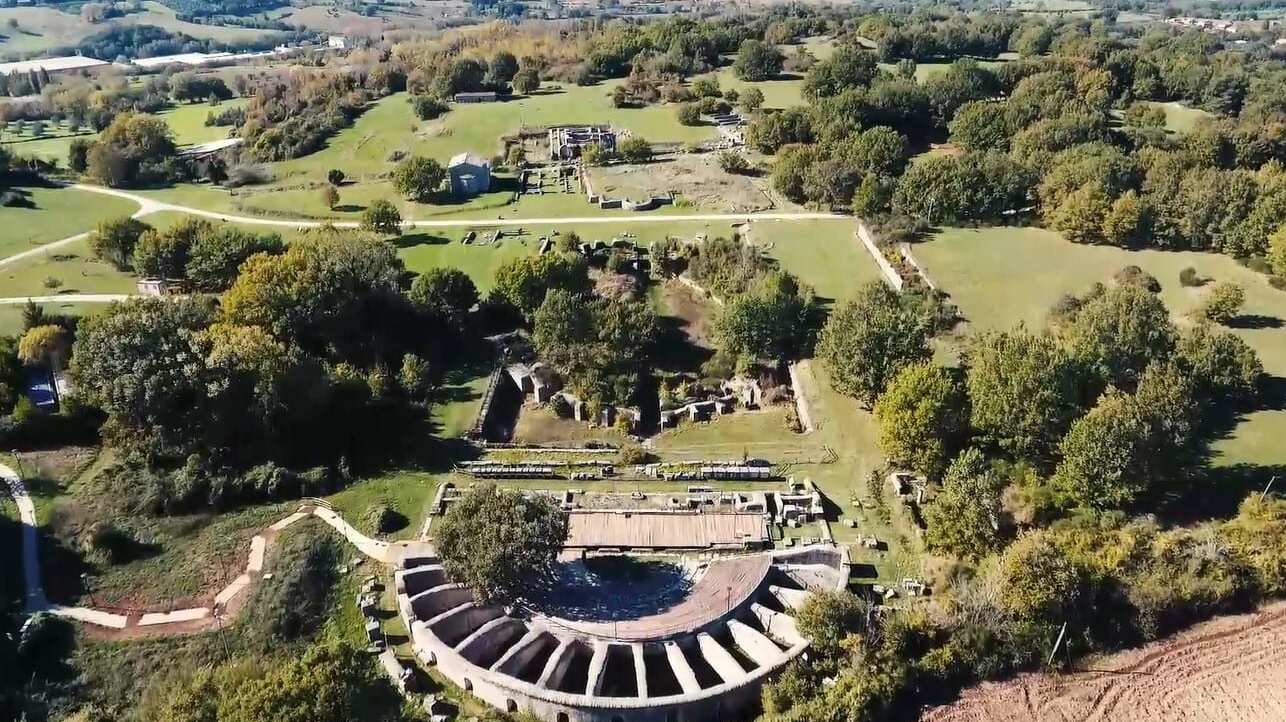

The ruins of the Roman city of Carsulae are located a short distance from Terni and the town of Sangemini, known for the presence of mineral water springs. The city was born along the Via Flaminia and in function of it, as a center of aggregation of pre-Roman populations living on the hills and in the nearby countryside: the territory was in fact frequented in a very intense way since the Middle Bronze Age, with settlements on strong positions, at the height of reliefs that dominated the plains below and the natural roads of communication. The opening of the Via Flaminia, traced between 220 and 219 B.C., represented a moment of great development for the neighbouring populations, who took it as a reference point for the transformation and evolution of their way of life. The traffic that took place along the artery stimulated the transfer of the populations towards the areas crossed by it; and it is in all probability in this phase that the centre of Carsulae rose.
The excavations, which followed in a disorderly fashion from the 16th century onwards and culminated in the intensive campaigns between 1951 and 1972, brought to light a large number of monuments and building structures, as well as a series of inscriptions, from which one can obtain the image of a rich and politically active town hall, whose inhabitants were governed by important magistrates and gathered in trade associations.
The choice of the site was dictated, as mentioned above, by mainly economic reasons, linked to the presence of a major communication route along which traffic between Rome and the Adriatic and more generally towards northern Italy; being on the edge of a fertile plain allowed a profitable agriculture; the decline of Carsulae and its abandonment were on the other hand in direct relation with the loss of importance of the western branch of the Flaminia, to the benefit of that for Interamna and Spoletium.Recent excavations have made it possible to recover some of the major public buildings in the city centre, in particular the forum and the area of entertainment buildings, all along the Flaminian Way, whose urban stretch is paved and bordered by sidewalks and canals, and whose northern entrance into the city is given by the large arch called the arch of S. Damiano, the remnant of a structure originally with three arches, built in cement works covered with slabs of travertine. Immediately outside the arch, two monumental burials have been restored, destined to important people and families in the city, one of which can be identified with the Furii. The hole, trapezoidal in shape, is placed at O della Flaminia, from which it is separated by two small four-sided arches that constitute the access;